Railway Work
in Melbourne
Rail Corridor Lifting and Possession Work Across Victoria
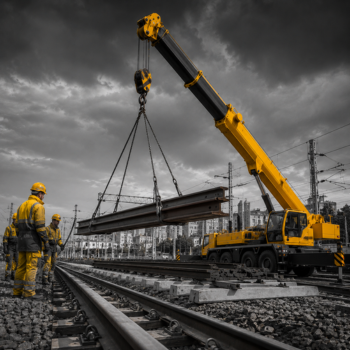
Rail projects need cranes, and rail is the most tightly controlled environment a crane works in. Track access is scheduled, personnel need current accreditation, the overhead is live unless it has been isolated, and the possession window does not move because a crane ran late.
This page sets out what rail crane work actually requires in Victoria, so you can check that whoever you engage meets it.

The Rule Most Contractors
Get Wrong
Rail accreditation does not apply only when a crane is physically inside the rail corridor. Metro Trains Melbourne requires Rail Safety Work and Rail Industry Worker accreditation for work within the corridor, work on station platforms crossing the yellow line, and any activity where plant, equipment, material, spoil or dropped objects could obstruct the Danger Zone. This includes site deliveries using cranes, slewing or boom-operated plant, mobile cranes and vehicle-loading cranes. A crane positioned on a nearby road may therefore be performing rail safety work if its boom or load crosses the boundary or a dropped object could reach the corridor or platform. If you are planning an engineered lift near a rail line, confirm these requirements before checking crane availability or pricing. Tell us the site and what you are lifting, and we will identify what applies across Melbourne, Geelong, Bacchus Marsh and Western Victoria.
What Rail Corridor Access Requires
The requirements are set nationally through the Rail Industry Worker program and applied by each network operator. In Victoria, the relevant operators include Metro Trains, V/Line, ARTC and VicTrack, and each has its own additions on top of the common base.
At minimum, personnel entering the rail corridor need:
- A valid Rail Industry Worker card. The national competency and identity system, administered through the RIW program, with the cardholder profile carrying qualifications, competencies, medicals, and network access history.
- Safely Access the Rail Corridor—the nationally recognized unit, TLIF2080, delivered by an approved provider.
- An approved rail medical. Category 1, 2, or 3 depending on the work role being performed, conducted by an authorized health professional.
- Construction induction. A current White Card or the equivalent statement of attainment.
- Network-specific inductions. Each operator adds its own. On the Metro Trains network, this includes Train Track Safety Awareness and Safely Work in the Rail Corridor, delivered through Metro Academy.
- High-risk work licenses. Rail accreditation sits on top of, not instead of, the WorkSafe Victoria licenses required for crane operation and rigging.
The RIW card is checked at the gate, and work does not proceed without it. Competencies also have to be current and correct for the specific role, not simply present on the profile.
What Rail Corridor Access Requires
The requirements are set nationally through the Rail Industry Worker program and applied by each network operator. In Victoria, the relevant operators include Metro Trains, V/Line, ARTC and VicTrack, and each has its own additions on top of the common base.
At minimum, personnel entering the rail corridor need:
A valid Rail Industry Worker card
Safely Access the Rail Corridor
An approved rail medical
Construction induction
Network-specific inductions
High-risk work licenses.
What Rail Projects Need Cranes For
Track and Civil Components
Sleepers, rail sections, turnout components, ballast handling, and track materials placed during possession work.
Station Infrastructure
Canopies, shelters, stairs, lift structures, platform components, and station furniture installed on operating and upgraded stations.
Signaling and Communications
Signal structures, masts, equipment huts, cable troughs and communications infrastructure placed along the corridor.
Overhead and Electrical
Structures, masts, transformers and electrical equipment installed where the overhead line environment governs the work.
Bridges and Structures
Bridge components, beams, culverts, precast elements and structural works on grade separation and level crossing projects.
Plant and Equipment Movement
Machinery, generators, containers and plant lifted into and out of the corridor, including recovery of failed equipment.
Call us now at 0457 000 637.
How Our Franna Hire Process Works
How Our Franna Hire Process Works
Four steps, one phone call. Start yours now.
Four steps, one phone call. Start yours now.
Tell us about the lift
Call, email or fill in the quote form with your site address, load weight, dimensions and required date. Photos and drawings help.
Tell us about the lift
Call, email or fill in the quote form with your site address, load weight, dimensions and required date. Photos and drawings help.
Get a fixed quote
We confirm the right Franna for the job, 20T, 25T or AT40, and send a clear, all-inclusive quote, usually the same day.
Get a fixed quote
We confirm the right Franna for the job, 20T, 25T or AT40, and send a clear, all-inclusive quote, usually the same day.
We plan and mobilize
Operator assigned, SWMS and lift plan prepared, rigging gear loaded. The crane drives to your site ready to work on arrival.
We plan and mobilize
Operator assigned, SWMS and lift plan prepared, rigging gear loaded. The crane drives to your site ready to work on arrival.
Lift, carry, done
Your load is lifted and placed safely and efficiently. We leave the site tidy and your program a step ahead of schedule.
Lift, carry, done
Your load is lifted and placed safely and efficiently. We leave the site tidy and your program a step ahead of schedule.
What Determines the Crane
Rail sites constrain crane selection more than most.
- Setup positions are limited. The corridor is narrow, the ground beside it is often unformed or on an embankment, and access points are fixed. That usually means the crane stands further from the work than it would elsewhere, which pushes the machine up in size for the same load.
- Slew is restricted. Where the crane works alongside a live line, the boom may be limited so it cannot swing over the operating track, which changes the geometry available.
- Overhead clearance governs everything. Working under or near overhead line equipment sets hard limits on boom height and position, whether or not the line is isolated.
- Ground bearing needs assessment. Rail reserves, embankment, and areas over services and structures all need bearing capacity confirmed before outriggers go down.
Send us the site layout, the access points, and the distance from where a crane can stand to where the load lands.
What Determines the Crane
Send us the site layout, the access points, and the distance from where a crane can stand to where the load lands.
Rail sites constrain crane selection more than most.
Do I need rail accreditation if the crane stays outside the corridor?
Often yes. Rail Safety Work covers any location where there is reasonable potential for plant, equipment,t or material to obstruct the Danger Zone, including dropped objects. A crane slewing a load across the boundary from outside is generally captured, even though the machine never enters the corridor.
What is a Rail Industry Worker card?
The national competency and identity system for rail workers, endorsed by the Australasian Railway Association and administered through the RIW program. The cardholder profile records qualifications, competencies, medicals, inductions and network access history, and the card is checked before corridor access.
What does someone need to work in the rail corridor in Victoria?
At minimum, a valid RIW card, Safely Access the Rail Corridor training, an approved rail medical at the category matching their work role, a construction induction card, and the network operator’s own inductions. Crane operators and riggers also need their WorkSafe Victoria high-risk work licenses.
Which network operators apply in Victoria?
Metro Trains, V/Line, ARTC and VicTrack are the relevant operators, and each sets its own requirements on top of the national program. The operator whose network you are working on determines what applies.
What extra does Metro Trains require?
Beyond the national base, Metro Trains requires its own inductions, including Train Track Safety Awareness and Safely Work in the Rail Corridor, delivered through Metro Academy, along with a health assessment by an authorized health professional.
What is a possession?
A scheduled period where a section of track is taken out of service so work can occur. Rail operates continuously unless an absolute occupation is in place, so most corridor work happens inside these windows, typically overnight or across a weekend.
What happens if the work overruns the possession?
The corridor has to be handed back regardless, which means work stops incomplete and the remaining scope waits for the next available window. That is why setup, rigging preparation, and contingency planning matter more on rail than anywhere else.
Can a crane work near live overhead lines?
Only under the controls that apply to that environment, which may include electrical isolation, an access permit, restricted boom positions, and exclusion distances. The work cannot begin until the required permits are in place.
Why does a rail job need a bigger crane than the load suggests?
Because setup positions are constrained. The corridor is narrow, access points are fixed, and the ground beside the track is frequently unsuitable, so the crane usually stands further from the work than it would on an ordinary site. Greater radius means less available capacity.
How far ahead should rail work be booked?
Well ahead. The network sets possession dates, accreditation and inductions take time to arrange, and lift documentation needs approval before the window. These are the jobs where a late inquiry most often cannot be accommodated.
What does rail crane work cost?
Rail work carries costs that ordinary lifting does not, including accreditation, night and weekend rates, extended setup, and the crane being on site ahead of the window. Call 0457 000 637 with the project details for a proper scope.
Which areas do you cover?
Melbourne metro and regional Victoria, with Maidstone, Werribee and Caroline Springs among the areas we attend most often, extending through Geelong, Bacchus Marsh, Melton and Ballarat.
0457 000 637
Open 24 hours
25 Rowsley Station Rd, Maddingley VIC 3340
Contact Us
Cranes reach site from 25 Rowsley Station Rd, Maddingley VIC 3340 on the Western Freeway. On possession work, arriving early is not a preference but a requirement, and the freeway corridor makes overnight and weekend starts across the western network realistic. Maidstone and the inner west sit across a dense network of suburban lines, level crossings and tram infrastructure. Work near those corridors frequently triggers rail requirements even when it is nominally a road job, which is worth checking before the lift is priced rather than after.