Transformer and
Switchboard
in Melbourne
Substation, Switchroom and Electrical Plant Lifting
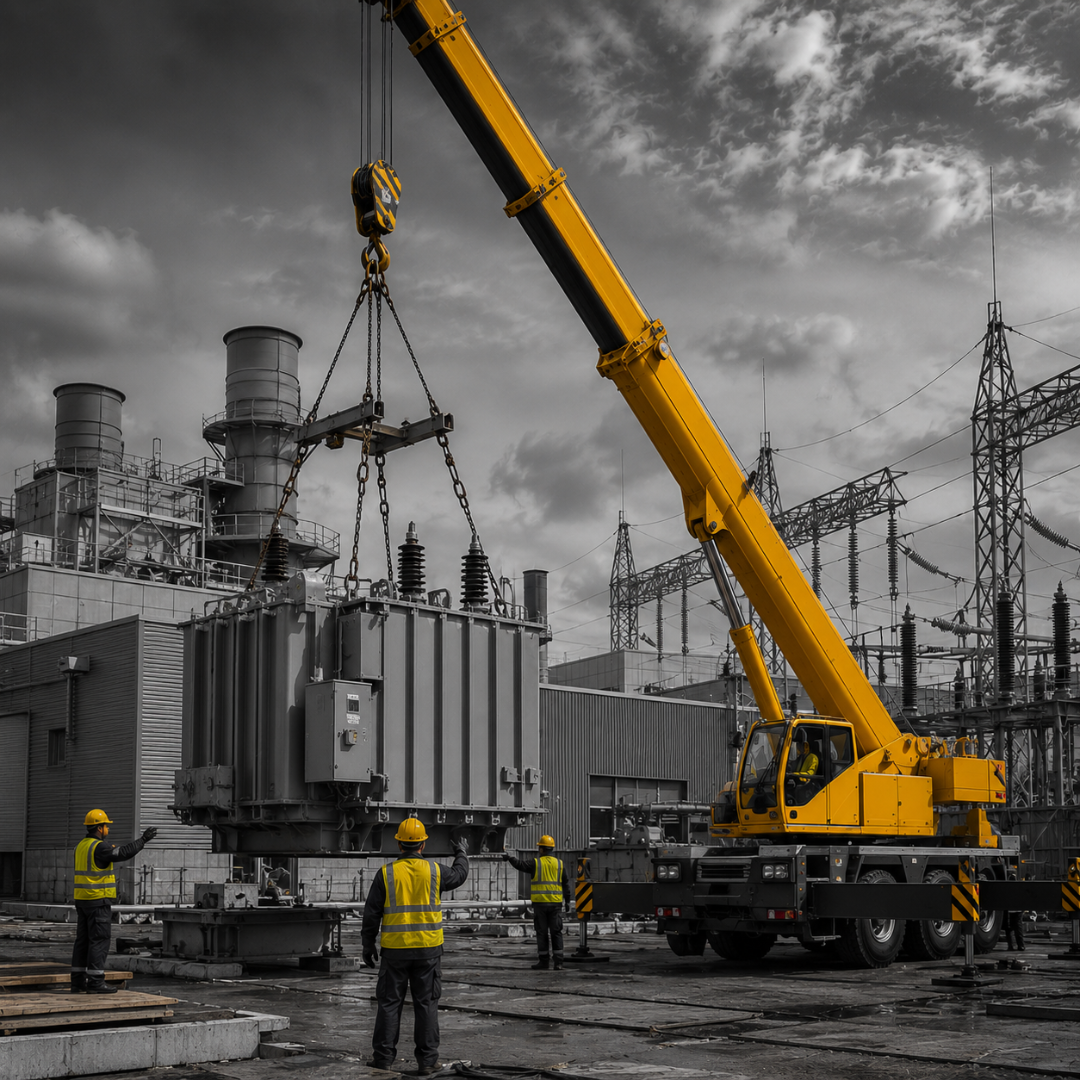
We lift transformers, switchboards, switchgear and electrical plant across Melbourne. Onto pads and bunds, into substations and switchrooms, out of plant rooms during upgrades, and in and out of buildings where the equipment has to travel further than the crane can reach.
These lifts are usually short. What makes them difficult is that the tolerance is tiny, the equipment is expensive and easily damaged, and the site is often congested and partly live.
Lift From the Lugs, Nothing Else
This is the rule that matters most on transformer work, and manufacturers are unanimous about it.
Transformers are lifted from their designated lifting lugs. Not from bushings, not from radiator brackets, not from valve flanges, and not from whatever else looks like it might take the weight. Those components are not lifting points and were never designed to be, and using them damages equipment that costs a great deal more than the crane hire does.
Units above around two tonnes generally require a spreader beam rather than slings straight to the hook. The reason is straightforward. Slings pulled in at an angle apply horizontal compression to the lugs, and the lugs are designed for a vertical pull. Side loading them risks the welds.
The lift also has to stay vertical. Manufacturer manuals commonly limit how far a transformer may tilt during lifting, often in the order of fifteen degrees from vertical, and that limit exists for a physical reason. The core, coils, fuses, and switches inside need to remain immersed in the dielectric fluid. Tip the unit too far,r and they are not.
Forklifts are frequently prohibited outright, with manufacturers attaching no forklift decals to the tank. If you have been told to unload one with a forklift, check the nameplate and the manual first.
Send us the unit details and the manual if you have it.
Substations Are Constrained Sites
Work inside an operating substation or switchyard leaves little room for error. Restricted access, live equipment, and hidden ground services create added constraints that must be considered before the crane is positioned.
- Space is the first constraint. Boom swing, outrigger spread, and working radius are often restricted. That can mean setting the crane further back and using a larger machine to achieve the required reach safely.
- Electrical clearance comes next. Live equipment and overhead assets require strict exclusion distances. Some lifts may also need isolation, permits and a registered electrical spotter before crane operations can begin.
- Ground support must be checked. Substation yards can contain cable trenches, earth grids and buried services. Outrigger positions should be confirmed before setup instead of relying only on the visible surface.
- Exclusion zones protect the crew. Personnel should remain clear while transformers and other heavy equipment are suspended. Controlled access around the lift reduces risk if the load shifts or moves unexpectedly.
- Planning keeps the job moving. These lifts are manageable when access, clearances, ground conditions, and permits are confirmed in advance. Good preparation prevents delays once the crane arrives on site.
Substations Are Constrained Sites
Work inside an operating substation or switchyard leaves little room for error. Restricted access, live equipment, and hidden ground services create added constraints that must be considered before the crane is positioned.
Space is the first constraint
Electrical clearance comes next
Ground support must be checked
Exclusion zones protect the crew
Planning keeps the job moving
What We Lift
Distribution Transformers
Pad-mounted and kiosk substations lifted onto prepared pads and bunds, on new estates, commercial developments and network upgrades.
Power Transformers
Larger units placed within substations and industrial sites, including replacements where the old unit comes out first.
Switchboards and Switchgear
Main switchboards, distribution boards, HV and LV switchgear lifted into switchrooms, plant rooms and prefabricated enclosures.
Generators and UPS Equipment
Standby generators, UPS units, batteries and associated plant lifted onto slabs, into plant rooms and onto roof decks.
Prefabricated Substations and Enclosures
Packaged substations, switchrooms and enclosures placed as complete units on prepared footings.
Removals and Replacements
Existing transformers and boards removed during upgrades and decommissioning, with the replacement landed in the same attendance where possible.
Call us now at 0457 000 637.
How The Job Runs
How The Job Runs
Start with the unit details and the site.
Start with the unit details and the site.
Send the unit and the site
Make, model, and weight; lifting lug arrangement; the manual if you have it; where it lands, where the crane can stand, and the access route if it is going inside.
Send the unit and the site
Make, model, and weight; lifting lug arrangement; the manual if you have it; where it lands, where the crane can stand, and the access route if it is going inside.
Method confirmed
Rigging planned to the manufacturer's requirements, crane selected against the radius, spotter and permit needs identified, and a quote issued.
Method confirmed
Rigging planned to the manufacturer's requirements, crane selected against the radius, spotter and permit needs identified, and a quote issued.
Approvals and scheduling
Isolations, permits, and site access arranged with the asset owner, and the date coordinated with your electrical contractor.
Approvals and scheduling
Isolations, permits, and site access arranged with the asset owner, and the date coordinated with your electrical contractor.
Lifted and placed
Unit rigged from the designated points, lifted level, positioned and held while alignment is confirmed, then released.
Lifted and placed
Unit rigged from the designated points, lifted level, positioned and held while alignment is confirmed, then released.
What the Job Includes
Six things covered on electrical plant lifts:
- Rigging to the manufacturer’s requirements. Designated lifting lugs, spreader beams where the unit calls for them, and a vertical lift within the specified tilt limits.
- Controlled placement. Lowering, holding while alignment and cable entries are checked, and adjusting before release rather than after.
- Ground and access assessment. Outrigger positions checked against trenches, earth grids and buried services, and the access route confirmed for internal work.
- Electrical spotters where required. Registered spotters supplied where the crane works within the specified distances of live or overhead assets.
- Lift documentation. SWMS, lift plans and ground bearing figures prepared where the site or asset owner requires them.
- Coordination with your electrical crew. Timing planned around isolations, permits and connection work so the crane is not billing while waiting for an access permit.
Working inside an operating substation or switchyard? Call 0457 000 637 early, because isolation and permit lead times set these dates rather than crane availability.
What the Job Includes
Working inside an operating substation or switchyard? Call 0457 000 637 early, because isolation and permit lead times set these dates rather than crane availability.
Six things covered on electrical plant lifts:
How should a transformer be lifted?
From its designated lifting lugs only, never from bushings, radiator brackets, or valve flanges. Units above roughly two tonnes generally need a spreader beam so the slings pull vertically rather than compressing the lugs inward, and the lift must stay within the tilt limit the manufacturer specifies.
Can a transformer be moved with a forklift?
Frequently not. Manufacturers often prohibit it and attach no forklift decals to the unit, because the weight distribution makes stabilization unsafe. Check the nameplate and manual before assuming a forklift is an option.
How far can a transformer be tilted?
Manuals commonly limit tilt during lifting to around fifteen degrees from vertical, with installed tilt held much tighter, often between two and four degrees. The limits exist because the internal core, coils, and switchgear must stay immersed in the dielectric fluid.
Why does the pad have to be perfectly level?
Because an installed tilt outside the specified limit shortens the life of the unit, the transformer also has to sit flush with no gaps between the base and the pad, and the cable entries have to align with the trench or conduit.
What is different about lifting a switchboard?
Switchboards are tall, thin, and rack easily. An uneven lift twists the frame, after which doors do not close properly, cubicles misalign, and busbar connections do not meet as designed. Keeping the board square through the lift matters more than the weight.
Can you lift inside a substation?
Absolutely. With articulated steering, a compact frame and no outriggers, a Franna operates in narrow laneways, congested sites and factories with limited head height where a slewing crane cannot set up.
Do I need an electrical spotter?
Where the crane operates within the specified distances of live overhead or ground assets, yes. On substation and network sites,s that is common rather than exceptional, and we arrange it.
Can you get a switchboard into a basement plant room?
Where the site and the electrical program allow it, yes, and it is considerably cheaper than two attendances. The constraint is usually the isolation window rather than the lifting.
Can you remove the old unit and install the new one in one visit?
Where the site and the electrical program allow it, yes, and it is considerably cheaper than two attendances. The constraint is usually the isolation window rather than the lifting.
What size crane is needed?
It depends on the unit weight and, more often, the radius. Substation and plant room work frequently forces the crane to stand well back from the landing position, which pushes the machine up in size for the same load.
What does transformer lifting cost in Melbourne?
Quoted on the crane size, the time on site including controlled placement, and whether spotters, permits and lift documentation apply. Call 0457 000 637 with the unit details and the site.
Which areas do you cover?
All Melbourne metro suburbs, with Maidstone, Werribee and Caroline Springs among the areas we attend most often, extending through Geelong, Bacchus Marsh, Melton and Ballarat, plus regional Victoria.
0457 000 637
Open 24 hours
25 Rowsley Station Rd, Maddingley VIC 3340
Contact Us
Melbourne is Victoria's capital and Australia's fastest-growing major city, with a construction pipeline that never slows down. The City of Melbourne and its surrounding councils keep approving record levels of development, and Crane2U supports it all from 25 Rowsley Station Rd, Maddingley VIC 3340, right on the Western Freeway corridor.