Concrete Panel Lifting
in Melbourne
Precast and Tilt-Up Panel Erection Across Victoria
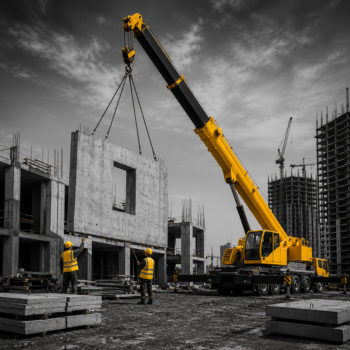
We supply cranes, riggers and dogmen for precast and tilt-up panel erection across Melbourne. Wall panels, facade elements, columns, stairs and structural precast are lifted and held while your erection crew braces them.
Panel work is the most heavily governed lifting most builders encounter. AS 3850 sets the requirements; the panels have to reach strength before they can be lifted, the inserts carry a mandated factor of safety, and the crane cannot let go until the bracing is on.

The Crane Waits for the Braces
On panel jobs, the crane’s time on site is governed by how quickly the bracing crew works, not by how fast the crane lifts. A panel cannot be released until it is properly braced or incorporated into the supporting structure, with at least two braces installed before the crane lets go. The lift takes only a few minutes, but the crane must continue holding the panel while the crew plumbs it, installs the braces and torques the connections. Preparation saves time, including marking brace positions from surveyed drawings, installing ground anchors before erection, fabricating braces to the specified dimensions off site, and stacking panels in erection order. We plan the sequence with your erection contractor because an extra ten minutes on each panel adds more than three hours to a twenty-panel job. Send us the panel schedule and site layout for projects across Melbourne, Geelong, Bacchus Marsh and Western Victoria.
What Has to Be Right Before We Lift
Panel erection has more preconditions than any other lift we do. These are the ones that stop jobs on the day.
Concrete strength achieved. Panels must reach the specified strength before lifting, commonly around 75 percent of 28-day design strength, verified by cylinder testing and the manufacturer’s certificate. A panel that has not reached it does not get lifted, regardless of the program.
Lifting inserts are correct and matched. Inserts must be cast in, comply with AS 3850, carry a factor of safety of 2.5 to 1 against failure of the insert, anchor, concrete and reinforcement, and match the lifting clutches being used. If the manufacturer’s markings are not visible, that gets resolved before anything is rigged.
Panels inspected before lifting. Cracking, concrete fatigue, damaged inserts, and incorrectly placed inserts all have to be identified before the panel leaves the stack, not while it is in the air.
Engineered lift plan approved. Crane setup position with no-go areas, pick and place locations, and the crane’s operating radius shown at each. On most sites, this must be approved by an engineer before erection begins.
Bracing designed and ready. Brace type, quantity, orientation, and ground anchor requirements designed by an engineer, with footings capable of resisting the applied loads and certification that the temporary support system complies with AS 3850.1.
Ground assessed for crane and braces. Bearing capacity confirmed under the crane outriggers and at the brace anchor locations, since both carry load.
Wind limits set. Maximum wind speed for erection determined and monitored, because a panel is a large flat surface and wind acts on all of it.
What Has to Be Right
Before We Lift
Panel erection has more preconditions than any other lift we do. These are the ones that stop jobs on the day.
Concrete strength achieved
Lifting inserts are correct and matched
Panels inspected before lifting
Engineered lift plan approved
Bracing designed and ready
Ground assessed for crane and braces
Wind limits set
What We Lift
Tilt-Up Wall Panels
Panels cast on site and lifted from the bed to vertical, with the crane holding through bracing on warehouse, industrial and commercial builds.
Precast Wall and Facade Panels
Factory-cast panels delivered to site and erected into position on commercial, retail and multi-level residential projects.
Structural Precast
Columns, beams, spandrels and structural elements placed and connected as part of a precast frame.
Stairs, Landings and Floor Units
Precast stair flights, landings, hollowcore and floor units lifted into position on multi-level builds.
Boundary and Retaining Panels
Precast retaining panels, boundary walls, sound walls and civil precast elements placed on infrastructure and residential works.
Panel Handling and Turning
Panels turned, repositioned, restacked or moved on site, including recovery where a panel has been delivered in the wrong sequence.
We proudly support the construction, civil, commercial, residential and industrial construction sectors, along with infrastructure, mining, manufacturing, logistics and warehousing clients throughout Victoria. If your load is not listed here, give us a ring; chances are we have lifted one just like it.
Call us now at 0457 000 637.
How the Job Runs
How the Job Runs
Start with the panel schedule.
Start with the panel schedule.
Send the panel schedule
Panel weights, dimensions, insert types and positions, quantity, stack or casting bed locations, and where each panel goes.
Send the panel schedule
Panel weights, dimensions, insert types and positions, quantity, stack or casting bed locations, and where each panel goes.
Crane and plan confirmed
Capacity checked across the full lift arc, setup position determined, ground assessed, and the lift plan prepared for engineer approval.
Crane and plan confirmed
Capacity checked across the full lift arc, setup position determined, ground assessed, and the lift plan prepared for engineer approval.
Sequence agreed
Erection order confirmed with your contractor, brace preparation checked, crew allocated, and the day planned panel by panel.
Sequence agreed
Erection order confirmed with your contractor, brace preparation checked, crew allocated, and the day planned panel by panel.
Erection
Panels inspected, rigged, lifted, positioned, and held while braced. Crane releases only once the bracing is complete.
Erection
Panels inspected, rigged, lifted, positioned, and held while braced. Crane releases only once the bracing is complete.
What We Supply
Six things provided for panel work:
Crane matched to the full lift arc. Selected against capacity at the maximum radius reached during rotation, not just the pick radius.
Ticketed riggers and dogmen. Crew licensed for the work, experienced in panel erection, and briefed on the sequence beforehand.
Rigging for panel geometry. Spreader arrangements, clutches, and sling configurations set up within the specified angle limits for the inserts fitted.
Lift plan preparation. Crane position, no-go areas, pick and place locations, and operating radii documented for engineer approval.
Ground bearing assessment. Pressures calculated for the crane in its working configuration, with mats and pads specified where the ground requires them.
Exclusion zone support. Setup that keeps everyone outside the zone except the crew releasing and bracing, which is what the requirements demand.
Erecting panels on a program? Call 0457 000 63,7, and we will price the crane across the sequence rather than day by day.
What We Supply
Erecting panels on a program? Call 0457 000 63,7, and we will price the crane across the sequence rather than day by day.
Six things provided for panel work:
What size crane do I need for panel lifting?
It depends on the heaviest panel and the radius at which it is lifted, but the figure that matters is capacity at the maximum radius reached during the lift, not at the pick position. On tilt-up, the radius increases as the panel rotates upright, which is when capacity is tightest.
Why does a tilt-up panel need a bigger crane than its weight suggests?
Because the effective radius grows as the panel rotates from flat to vertical, the crane’s available capacity drops as that happens, so the machine has to be sized against the worst point in the arc rather than the panel weight alone.
When can the crane release the panel?
Only once the panel is adequately braced or incorporated into the supporting structure, with a minimum of two braces installed, if braces are fitted after positioning, the crane holds the panel throughout.
How long does the crane need to be on site?
Longer than the lifting takes. Crane time on panel jobs is largely determined by how quickly your crew braces each panel. Preparation beforehand, brace positions marked, ground anchors installed, and braces pre-fabricated are what shortens the day.
What strength does the concrete need before lifting?
Panels must reach the specified lifting strength, commonly around 75 percent of the 228-daydesign strength, verified by cylinder testing with a manufacturer’s certificate. Panels below strength are not lifted.
What are the requirements for lifting inserts?
Inserts must be cast in, comply with AS 3850, and provide a factor of safety of 2.5 to 1 against failure of the insert, the anchor, the concrete, and the reinforcement. They must match the lifting clutches, and the manufacturer’s markings should remain visible after casting.
What sling angles apply to panel lifting?
Slings are limited in how far they can sit from vertical, commonly a maximum of 60 degrees with 45 degrees preferred, because the angle changes the load on each insert. That usually means a spreader arrangement rather than a simple sling.
Do I need an engineered lift plan?
For panel work, effectively yes. Most principal contractors require a lift plan approved by an engineer, showing crane setup position, no-go areas, pick and place locations, and the operating radius at each. We prepare it.
Can wind stop panel erection?
Yes, and it is a documented control rather than a judgment call. Maximum wind speeds for erection are specified and monitored, because a panel presents a large flat surface and wind acts across all of it.
Do you erect the panels, or just supply the crane?
We supply the crane, the operator, and a ticketed rigging crew, and work alongside your panel erection contractor who handles bracing, inserts, and the engineering. Tell us how your job is structured and we will confirm exactly what we cover.
What happens if a panel is cracked or an insert is damaged?
It does not get lifted until an engineer approves an alternative. Panels are inspected before rigging for cracking, fatigue,e and insert condition, because these are found on the ground or not at all.
What does concrete panel lifting cost in Melbourne?
Panel jobs are quoted on the crane size, the number of panels, and the expected duration, which is driven by bracing time more than lifting time. Programs are priced across the sequence rather than day by day. Call 0457 000 637 with the panel schedule.
Which areas do you cover?
All Melbourne metro suburbs, with Maidstone, Werribee and Caroline Springs among the areas we attend most often, extending through Geelong, Bacchus Marsh, Melton and Ballarat, plus regional Victoria.
0457 000 637
Open 24 hours
25 Rowsley Station Rd, Maddingley VIC 3340
Contact Us
Cranes reach site from 25 Rowsley Station Rd, Maddingley VIC 3340 on the Western Freeway. Panel jobs start early and run through the day, so being on the freeway corridor means the crane is set up and ready rather than arriving into peak traffic. Maidstone runs to smaller precast on constrained sites. Boundary walls, retaining panels and facade elements on infill developments, where the crane position and the reach over the block matter more than the panel weight.